

Understanding the Difference Between Two Leading Lightning Protection Technologies
(By SN Engineering – Trusted Manufacturer of Earthing & Lightning Protection Systems)
🔹 1. Basic Principle
| Type | Conventional Lightning Arrester (LA) | ESE Lightning Arrester (Early Streamer Emission LA) |
|---|---|---|
| Working Principle | Provides a passive point of discharge — lightning is captured when it naturally strikes the air terminal. | Uses an active triggering mechanism to create an early upward leader, attracting lightning before it strikes nearby structures. |
| Technology Type | Passive System | Active System (Advanced Technology) |
| Response Time | Natural response (no time gain) | Early triggering of up to 60–65 microseconds before natural leaders |
🔹 2. Protection Radius
| Type | Conventional LA | ESE LA |
|---|---|---|
| Protection Range | Limited — typically covers only the height of the rod plus a small surrounding radius. | Very wide — provides a large protection radius (up to 79m for ESE 60 model, depending on height). |
| Typical Application Area | Small buildings, houses, small commercial spaces. | Large buildings, industrial plants, telecom towers, solar fields, oil & gas facilities. |
🔹 3. Components Used
| Conventional LA | ESE LA |
|---|---|
| Air Terminal Rod | ESE Air Terminal with triggering mechanism |
| Down Conductor | Down Conductor |
| Earth Termination | Earth Termination (Chemical Earthing) |
| Surge Protector (Optional) | Surge Protector (Mandatory with ESE systems) |
🔹 4. Installation & Design
| Aspect | Conventional LA | ESE LA |
|---|---|---|
| Design Simplicity | Simple installation; only air rod and earthing required. | Requires design as per IEC 62305 & NFC 17-102 standards with precise height calculations. |
| Number of Units Needed | Multiple rods for large coverage. | Single ESE LA can protect large area. |
| Aesthetics & Space | Requires more installation points. | Compact, single-point protection. |
🔹 5. Maintenance & Reliability
| Conventional LA | ESE LA |
|---|---|
| Low maintenance, but limited protection range. | Virtually maintenance-free and offers broader, predictable protection. |
| Needs multiple rods for full coverage. | Single ESE device reduces complexity. |
🔹 6. Standards & Compliance
| Type | Conventional LA | ESE LA |
|---|---|---|
| Design Standard | IS/IEC 62305, IS 2309 | NFC 17-102:2011, IEC 62305 |
| Testing | Standard HV Test | Impulse current and time advance test |
| Approval | Widely accepted for traditional systems | Approved for modern high-risk installations (industrial, data, telecom, etc.) |
🔹 7. Cost & Performance
| Aspect | Conventional LA | ESE LA |
|---|---|---|
| Initial Cost | Lower (basic setup). | Higher initial investment. |
| Long-Term Value | Multiple units increase cost for large areas. | Single ESE unit provides cost efficiency and high protection over larger area. |
| Performance | Effective for small structures. | Highly efficient for modern large-scale infrastructure. |
✅ Conclusion: Which One Should You Choose?
| Scenario | Recommended Type |
|---|---|
| Small homes, residential buildings | Conventional Lightning Arrester |
| Industrial, commercial, telecom, solar, or oil & gas projects | ESE Lightning Arrester (ESE LA) |
| Where wide coverage and advanced protection are needed | ESE LA |
| Where cost and simplicity are priorities | Conventional LA |
💡 SN Engineering Recommendation
For critical infrastructure, telecom towers, solar plants, and industrial complexes,
SN Engineering recommends ESE Lightning Arresters due to their extended protection radius, modern technology, and compliance with IEC & NFC standards.For smaller commercial or residential projects, Conventional LAs remain an affordable and reliable solution.
🧠 Key Advantages of SN Engineering LAs
Manufactured as per IEC 62305 & NFC 17-102 standards
Copper bonded and SS316 options available
CPRI & PWD approved lightning protection systems
Designed with custom height and protection radius calculations
Integrated with chemical earthing and surge protection devices (SPD)
🔍 SEO Keywords
Conventional Lightning Arrester | ESE Lightning Arrester | Early Streamer Emission LA | ESE vs Conventional Lightning Arrester | SN Engineering Lightning Protection | IEC 62305 Lightning Protection | NFC 17-102 Lightning Arrester | Lightning Protection System India | Copper Bonded LA | Lightning Protection Comparison
📱 Suggested Hashtags
#ESELightningArrester
#ConventionalLightningArrester
#SNEngineering
#LightningProtection
#ESEvsConventional
#IECLightningProtection
#NFC17102
#ElectricalSafety
#IndustrialProtection
#LightningSafety
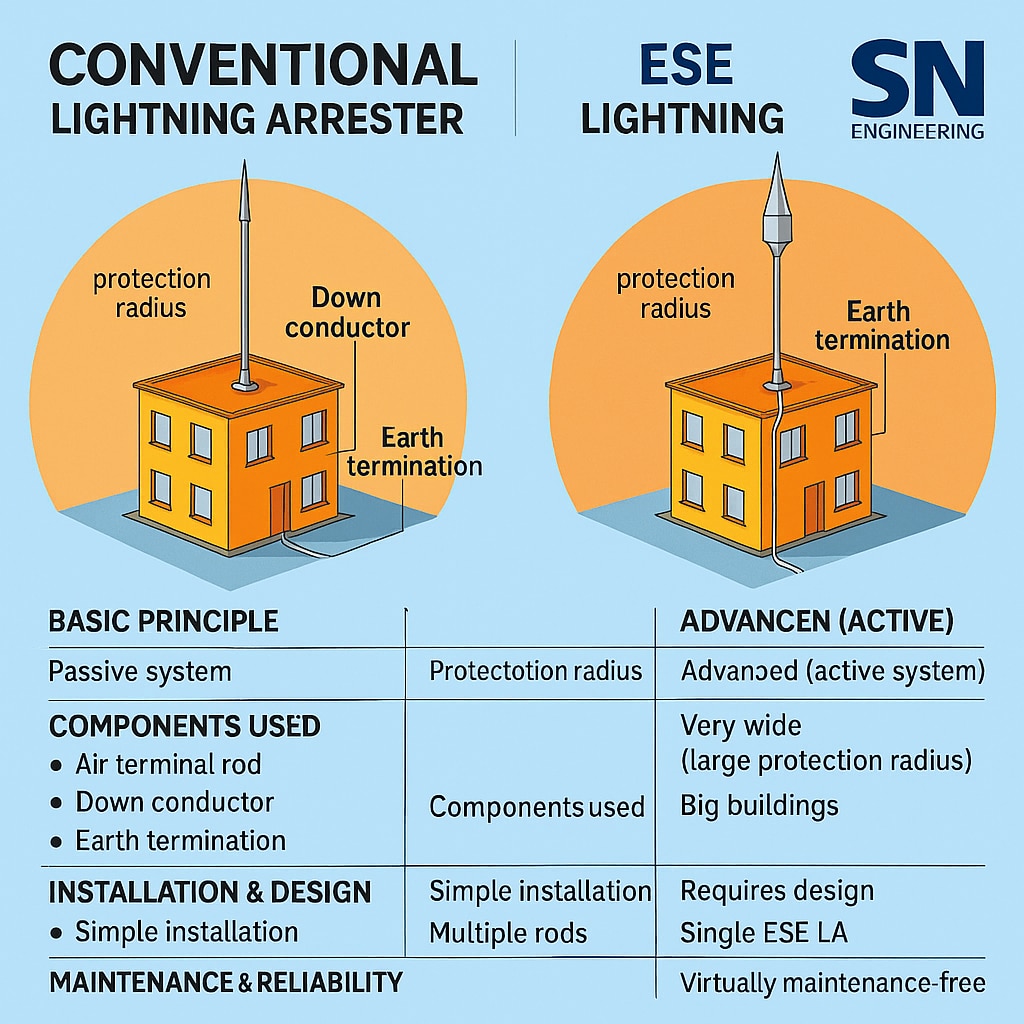
Conventional Lightning Arrester vs. ESE (Early Streamer Emission) Lightning Arrester
Lightning protection is essential for safeguarding structures from lightning strikes. Among the different types of lightning protection systems, Conventional Lightning Arresters and ESE Lightning Arresters are commonly used. Both serve to protect buildings, but they work on different principles. Let’s dive into the differences and advantages of each type.
1. Conventional Lightning Arrester (CLP)
Working Principle:
- Conventional Lightning Arresters function based on a simple rod or terminal system that is mounted on top of a building or structure. The arrester is connected to the ground via conductors.
- When lightning strikes, the lightning arrester provides a path of least resistance for the current, directing the lightning into the ground.
- The basic principle is that the lightning will strike the highest point in the surrounding area, and the arrester will serve as that point.
Components:
- Air terminal: The topmost part of the system.
- Down conductor: Carries the current from the air terminal to the ground.
- Earth electrode: Dissipates the energy safely into the earth.
Advantages:
- Simplicity: Conventional systems are relatively simple to design and install.
- Cost-Effective: They are usually less expensive compared to more advanced systems like ESE.
- Widely Used: Conventional arresters have been used for decades and are well-understood in terms of performance and reliability.
Disadvantages:
- Late Triggering: Conventional lightning arresters generally trigger after the lightning strike has begun, which means they may not intercept a lightning strike at the earliest possible moment.
- Limited Protection: They have a limited protection zone. They rely on the strike hitting the highest point of the structure, which might not always be effective in preventing damage.
2. ESE (Early Streamer Emission) Lightning Arrester
Working Principle:
- ESE Lightning Arresters use a more advanced technology that aims to attract and intercept lightning strikes before they happen.
- The ESE arrester generates a controlled early streamer emission, which creates an ionized path to the ground before the lightning strike occurs. This early triggering allows the arrester to intercept the lightning strike at an early stage, leading the strike safely to the ground.
- The concept behind ESE arresters is to increase the probability of lightning hitting the arrester rather than the structure.
Components:
- Air Terminal: Usually equipped with an ionization system to emit an early streamer.
- Down Conductor: Directs the current to the ground.
- Grounding Electrode: Safely dissipates the electrical energy into the earth.
Advantages:
- Early Strike Interception: ESE arresters are designed to intercept lightning strikes before they reach the structure, providing enhanced protection against direct hits.
- Wider Protection Zone: They provide a larger protection zone around the structure, which can be very beneficial for taller buildings or structures in lightning-prone areas.
- Reduced Risk of Structural Damage: By intercepting lightning before it strikes, the ESE system can reduce the risk of damage to the structure and electrical equipment.
- Enhanced Safety: ESE arresters can be especially effective in areas that experience frequent thunderstorms, offering more reliable protection against lightning-related hazards.
Disadvantages:
- Higher Cost: ESE lightning arresters are typically more expensive than conventional ones, due to the more sophisticated technology used.
- Complexity: The installation of ESE systems is more complex and may require expert installation to ensure they are working correctly.
- Regulatory Acceptance: In some countries or regions, the use of ESE lightning arresters may still be under scrutiny, with some standards only recognizing conventional lightning protection systems.
Key Differences:
| Feature | Conventional Lightning Arrester | ESE Lightning Arrester |
|---|---|---|
| Technology | Simple, based on air terminals and down conductors. | Advanced, with ionization and early streamer emission. |
| Triggering Time | After the lightning strike has already begun. | Emits an early streamer to attract the strike before it occurs. |
| Protection Zone | Smaller, limited to the highest point in the structure. | Larger, offers a wider area of protection. |
| Cost | Generally lower cost. | Higher cost due to advanced technology. |
| Complexity of Installation | Relatively simple to install. | More complex installation and commissioning. |
| Reliability | Reliable but may not intercept every strike early. | High reliability with earlier interception of strikes. |
| Maintenance | Minimal, requires occasional checks. | Low maintenance but must ensure ionization systems are intact. |
| Preferred Locations | Suitable for small to medium-sized buildings. | Suitable for high-rise buildings or areas with frequent lightning. |
Which One Should You Choose?
- Conventional Lightning Arresters are suitable for structures with lower lightning strike risk or where budget is a concern. They are effective for many applications and have been in use for years with proven reliability.
- ESE Lightning Arresters are ideal for high-risk lightning areas, tall buildings, or critical installations where advanced protection is required. They offer enhanced protection with the ability to intercept strikes earlier, preventing damage and reducing the risk of fire or electrical surges.
Conclusion:
- If you're looking for cost-effective and simple protection for a smaller structure or a building with lower lightning strike frequency, a Conventional Lightning Arrester might be the best choice.
- If your building is in an area with frequent thunderstorms, is tall, or has high-value equipment, opting for an ESE Lightning Arrester will give you superior protection by intercepting lightning strikes earlier and reducing the risk of damage.
Both systems serve the same purpose—protection from lightning—but the choice depends on the specific needs of your building, budget, and the environmental factors in your area.
 vs ESE Lightning Arrester (ESE LA))