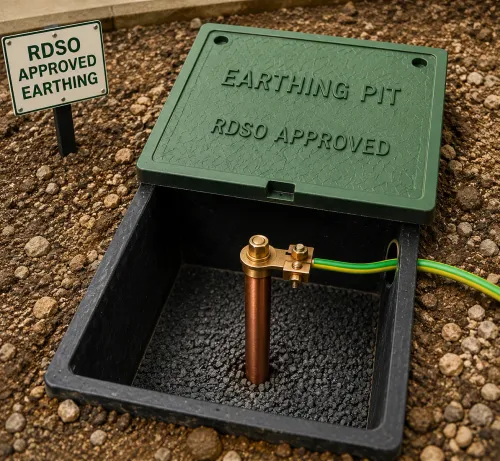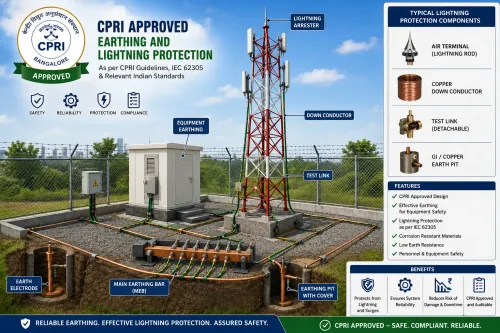
🌍 What is Chemical Earthing?
Chemical Earthing is an advanced earthing system that provides a safe path for fault currents to flow into the ground, protecting people, equipment, and buildings from electrical hazards like electric shock, fire, or equipment damage.
Unlike traditional earthing (which uses charcoal and salt and requires frequent maintenance), chemical earthing uses a specially designed electrode filled with eco-friendly, conductive backfill compound. This compound retains moisture, resists corrosion, and ensures low and stable earth resistance for many years.
---
⚡ Key Features of Chemical Earthing
✅ Maintenance-Free – No need to regularly add water, salt, or charcoal.
✅ Long Life – Typically lasts 15–20 years, compared to 5–7 years for conventional systems.
✅ Low Resistance – Provides consistent and reliable grounding even in rocky or dry soil.
✅ Corrosion-Free – Copper-bonded or GI electrodes with protective backfill compound prevent rusting.
✅ Safe & Reliable – Reduces risk of electric shock, fire, and equipment failure.
🔧 Components of a Chemical Earthing System
1. Earthing Electrode – Copper-bonded or GI (galvanized iron) pipe/rod that carries fault current.
2. Backfill Compound (BFC) – Special chemical mixture that maintains moisture and conductivity around the electrode.
3. Earth Pit Chamber – Top covering (usually FRP or concrete) to access the electrode for testing.
🏭 Applications
Chemical earthing is widely used in:
Power plants & substations
Telecom towers & data centers
Hospitals & commercial complexes
Industrial plants & factories
Residential buildings & housing societies
---
👉 In short, Chemical Earthing = Modern, Reliable, and Maintenance-Free Earthing Solution that ensures safety and uninterrupted power system performance.